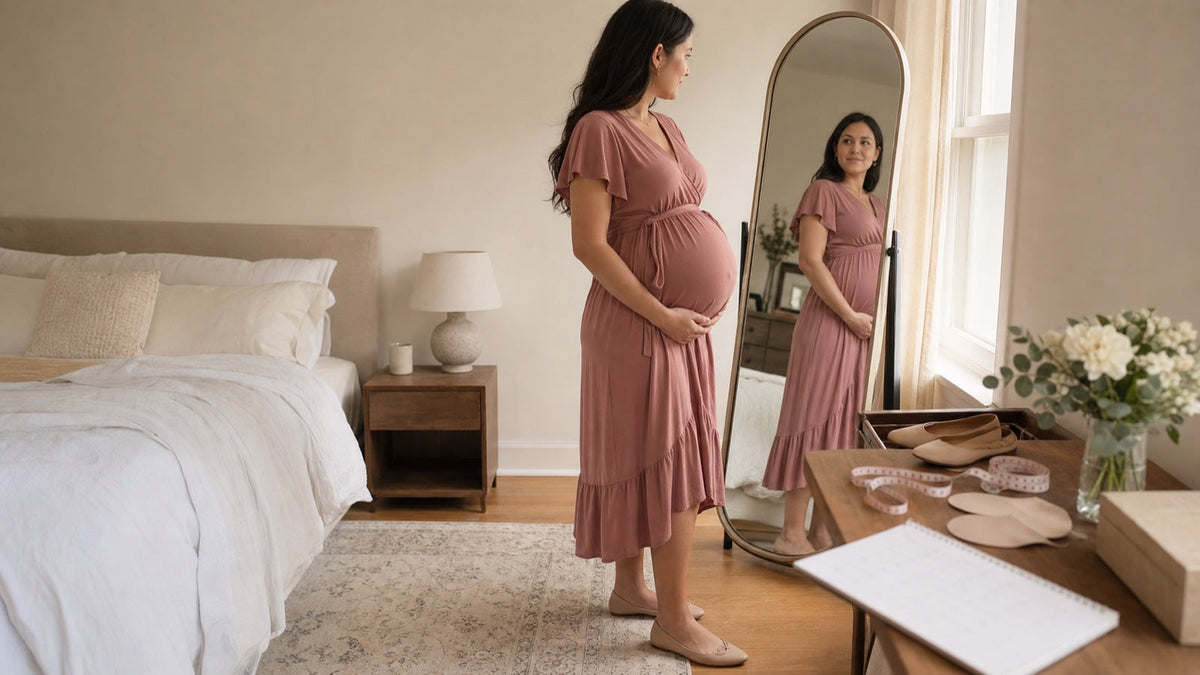
The hardest part of choosing a maternity dress for your baby shower is not finding something beautiful. It is choosing a dress today for a body you will have several weeks from now.
Your bump may grow. Your bust may change faster than the rest of your body. A maxi dress may sit at a different length once it moves over your belly. And because your shower happens on one specific date, a dress that arrives late—or leaves no time for a size change—is not really the right dress.
This guide helps you evaluate fit, fabric, coverage and timing before you order.
Choose for your shower date, not for today
Start with the date of your baby shower and calculate how many weeks pregnant you expect to be that day.
That number matters because a dress that feels roomy at 22 weeks may fit very differently at 28 or 32 weeks. You do not need to predict your exact measurements. You do need to understand which parts of the dress can adapt.
Look for:
- Stretch through the bump rather than only at the waist
- Enough room across the bust and ribcage
- Adjustable straps, a flexible back or a forgiving neckline
- A waist seam designed to sit above—not across—the fullest part of your bump
- A skirt that can move forward over your belly without becoming too short in front
If a product page only says “true to size,” you still need more information. True to which measurement: your pre-pregnancy size, your current bust, or the dress measurements?
Decide which measurement should lead
For many maternity dresses, your pre-pregnancy size is a useful starting point. It should not be the only rule.
Use the least flexible part of the dress to guide your decision:
- For a fitted bodice with limited stretch, prioritize your current bust measurement.
- For a smocked or elastic bodice, check both the relaxed and stretched measurements.
- For an empire-waist dress, confirm that the seam will sit comfortably below your bust and above your bump.
- For a bodycon dress, compare the fabric stretch and recovery—not only the listed waist measurement.
- For a dress with a zipper, measure the point the zipper must pass: often the bust or ribcage.
If your bust and pre-pregnancy size point to different sizes, do not automatically size up everywhere. A larger size can solve tightness in one area while creating loose shoulders, a low neckline or too much fabric around the skirt. Look for a silhouette that accommodates the difference instead.
Check the bust, neckline and bra before the bump
The bump is visually obvious, so it gets most of the attention. In practice, the bust and neckline often determine whether a maternity baby shower dress feels secure.
Before ordering, ask:
- Is the bust area stretchy, lined or structured?
- Does the dress include fixed cups, and are their dimensions shown?
- Can the straps be adjusted?
- Will your preferred bra work with the neckline and back?
- Does the neckline stay in place when you sit, bend and raise your arms?
- If the dress is off-the-shoulder, what keeps it from sliding?
A beautiful dress should not require you to keep pulling it up throughout your shower.
Use your height to predict the real hemline
Pregnancy changes how a dress hangs. As the skirt travels over the bump, the front hem may lift. At the same time, a long dress can still pool at the back if you are petite.
The most useful product pages give three pieces of information:
- The dress length and where it was measured from
- The model’s height and pregnancy week
- The shoes worn in the photos
For a maxi dress, decide whether you want it to touch the floor in heels, skim the ankle in flats or stay clear of the ground. If you expect to wear comfortable low shoes, do not evaluate the length from a photo styled with tall heels.
If alterations may be necessary, include that time in your order plan.
Look beyond “soft” and “premium” fabric descriptions
Words such as soft, luxurious and high quality do not tell you whether a light-colored dress will be see-through.
Look for specific product evidence:
- Fabric composition
- Lining location and length
- Whether the bust is double layered
- Stretch direction and degree
- Close-up photos of the fabric texture
- Photos in daylight, indoor light and with flash
- Guidance for nude, seamless or strapless undergarments
Light colors do not have to be avoided. Ivory, blush and powder blue can photograph beautifully. They simply need clearer evidence because bright windows, direct sunlight and camera flash can reveal more than soft studio lighting.
When your dress arrives, test it near a window and take a phone photo with flash. Do this while you still have time to change your plan.
Make sure the dress works while you move
Your baby shower is not a standing photo. You will sit, hug guests, open gifts, reach across tables and possibly walk on grass or stairs.
During your try-on, test these movements:
- Sit for several minutes without the waist or under-bust seam digging in
- Raise both arms and check the hem and neckline
- Bend slightly and confirm the bust remains covered
- Walk in the shoes you plan to wear
- Turn sideways and check whether the lining and outer layer move together
- Take photos from the front, side and back
The side view matters. It shows whether the waistline defines your bump, cuts across it or adds unnecessary volume.
Plan around the event date
Do not treat the shipping estimate as the only date that matters. You need time to receive, inspect and try on the dress—and possibly order another size.
Work backward from your shower:
- Event date
- Final day you are comfortable receiving a replacement
- Time needed for a replacement or alteration
- First try-on and quality check
- Estimated delivery date
- Order date
If the first dress would arrive only a day or two before your shower, you are not buying a dress. You are buying a deadline risk.
Check whether the item is ready to ship, made to order or backordered. Read the return window from the delivery date, and confirm whether the brand offers exchanges or requires you to return and place a new order.
Read the return terms before choosing between sizes
If you are considering ordering two sizes, first confirm:
- Whether either size is Final Sale
- Whether return shipping is deducted
- Whether separate orders require separate return fees
- Whether exchanges are available
- How quickly refunds are processed
- Whether the return window leaves enough time before your event
The best time to understand a return policy is before your payment, not after the dress arrives.
Maternity or bump-friendly: which is better?
A maternity dress is designed around pregnancy proportions. A bump-friendly dress is usually a regular dress with enough stretch, gathering or volume to accommodate a bump.
Neither label automatically guarantees a better fit.
A maternity dress may be the safer choice when you need:
- More room through the front body
- An empire waist positioned for pregnancy
- A front hem shaped around the bump
- Pregnancy-specific bust or nursing features
A bump-friendly dress may be useful when you want:
- A relaxed silhouette you can wear after pregnancy
- A smocked or wrap construction
- A style that does not look traditionally maternity
Evaluate the construction, not only the category name.
Your baby shower dress fit checklist
Before ordering, confirm:
- Your expected pregnancy week on the shower date
- Current bust and bump measurements
- Pre-pregnancy size as a reference
- Model height, pregnancy week and worn size
- Dress length and shoe plan
- Fabric composition, stretch and lining
- Bra compatibility and neckline security
- Estimated delivery and replacement buffer
- Return fees, Final Sale status and exchange method
If a product page cannot answer the points that matter to you, ask before ordering. A real answer is more valuable than guessing between two sizes.
The goal is confidence, not a perfect measurement
Pregnancy is changing. Your dress does not need to predict every centimeter. It needs enough flexibility in the right places, enough evidence to make a sensible decision and enough delivery time to solve a problem if one appears.
Choose for the body you will have on the day. Then choose the dress that lets you stop thinking about the dress and stay present for the moment.
Use this checklist as you compare baby shower dresses for your shower date. A specific answer about fit, fabric or delivery is more useful than guessing between two sizes.
Frequently asked questions
Should I buy my pre-pregnancy size for a maternity baby shower dress?
Use your pre-pregnancy size as a starting point, then compare your current bust, the dress measurements and the fabric stretch. If the bodice has limited stretch, your bust may need to lead the decision.
How early should I order my baby shower dress?
Order early enough to receive and inspect the dress, try it with your shoes and undergarments, and still have time for a replacement or alteration. Use the estimated delivery date and return process rather than a universal number of weeks.
What if I am between sizes while pregnant?
Choose based on the least flexible area of the dress. A flexible bump panel cannot compensate for a tight bust, fixed zipper or narrow neckline. If sizing up makes the shoulders too loose, consider a different silhouette.
How can I tell if a light maternity dress will be see-through?
Check the fabric composition, lining coverage and photos in different lighting. After delivery, test the dress in daylight and with camera flash while you still have time to return or exchange it.
Can I wear a non-maternity dress to my baby shower?
Yes, if the construction accommodates your bump and bust on the event date. Smocking, wraps, flexible waist placement and enough front length matter more than the label “bump-friendly.”

