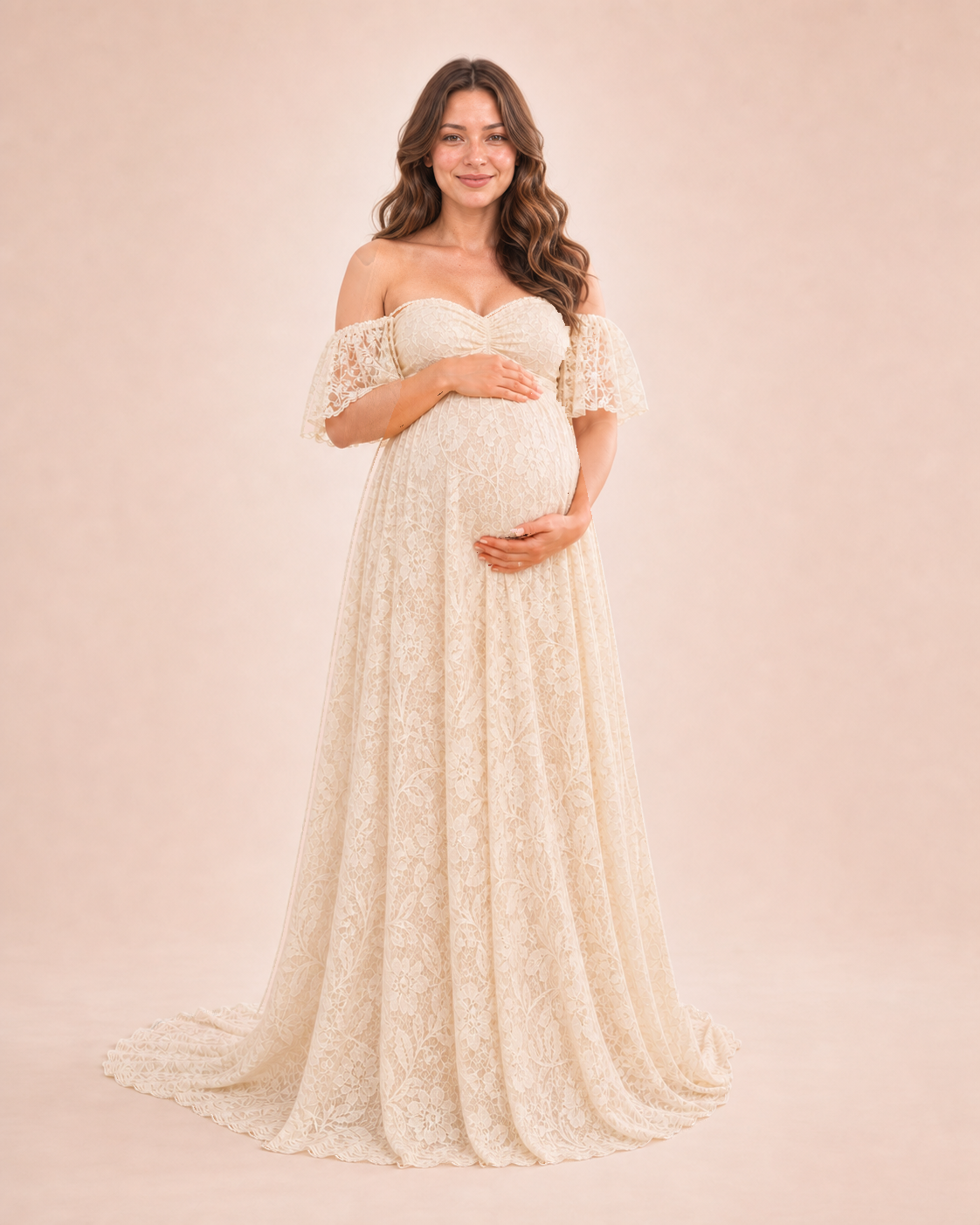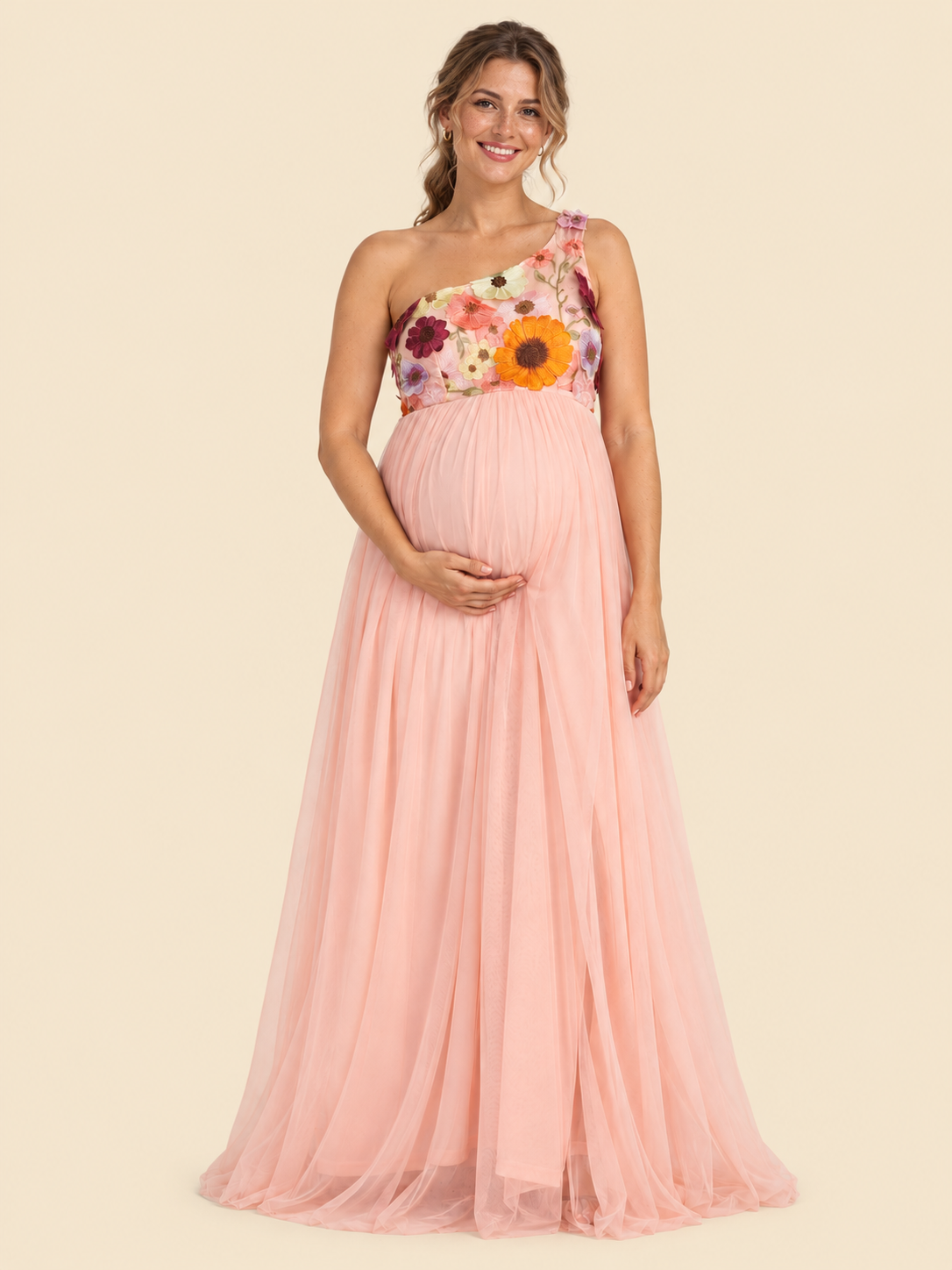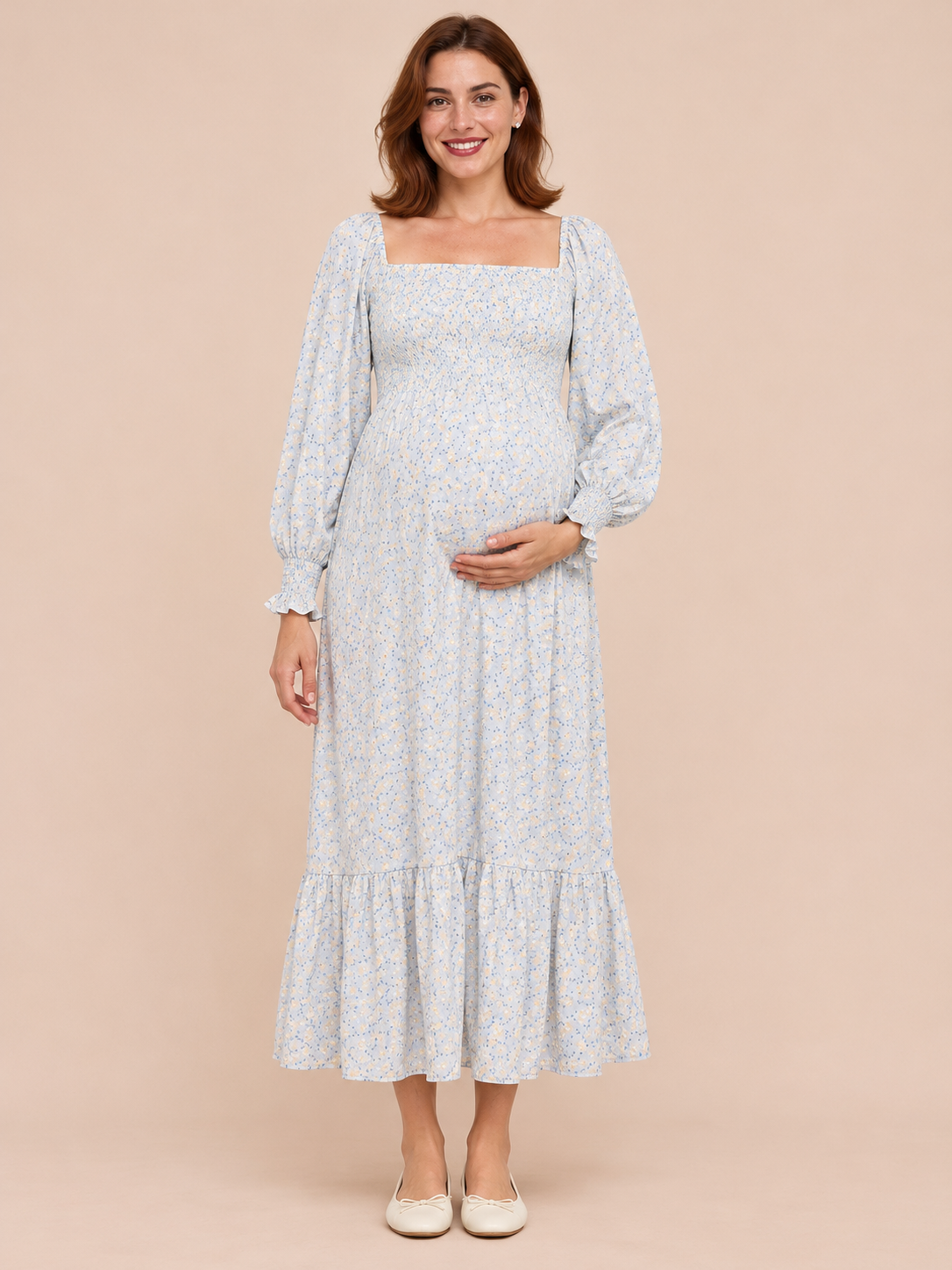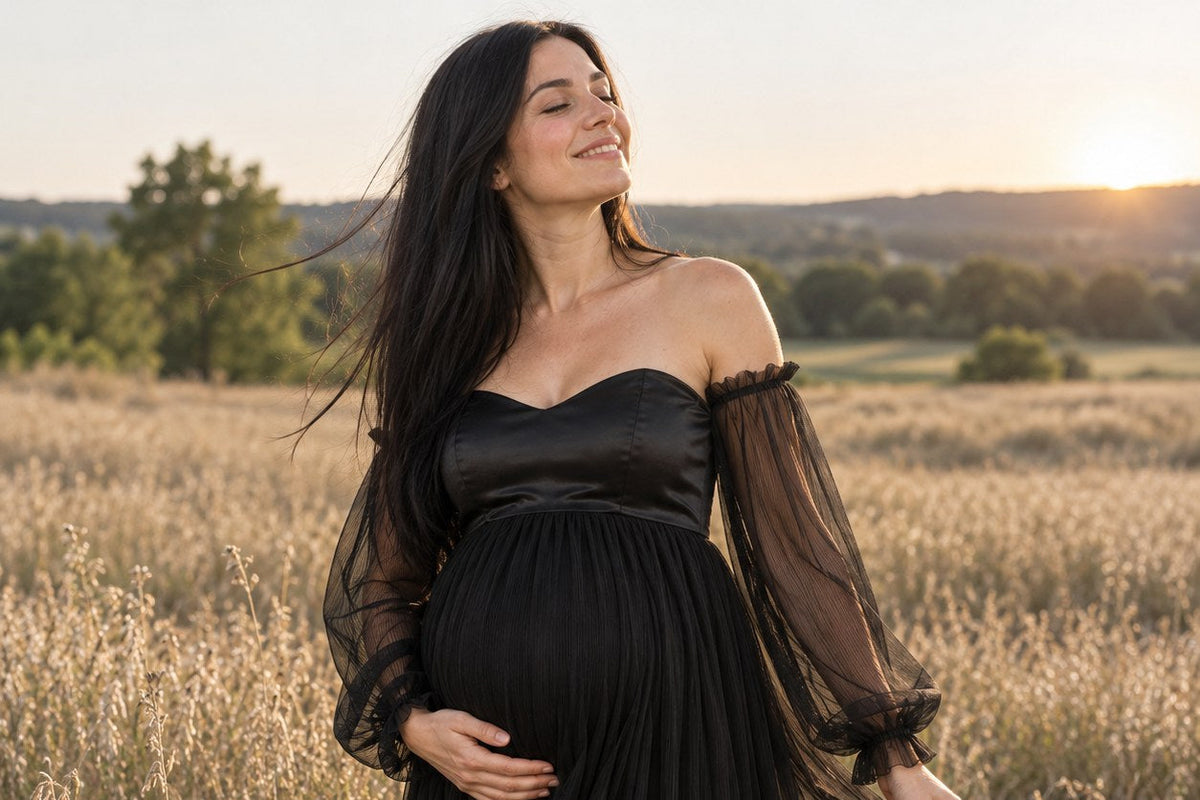
Yes, you can reuse a maternity photoshoot dress with train for your baby shower, but the dress needs to work for more than a still pose. Check the front hem, the length and handling of the back hem, and how the dress feels while you walk, sit, hug, and open gifts. A train that creates a beautiful line in a quiet portrait may need to be lifted, detached, or exchanged for a no-train option when the celebration begins.
Can a Maternity Photoshoot Dress With Train Work at a Baby Shower?
A maternity photoshoot dress with train can work at a baby shower when the front clears your shoes, the back stays manageable in your venue, and you can sit without trapping the part that gives the skirt its shape. The words “photoshoot” and “baby shower” beside the same dress are a starting point, not the whole decision.
Picture the two moments separately. During a studio portrait, you may stand in one place while someone arranges the drape. At your shower, you may cross a room to greet family, turn for photos, settle into a chair, lean toward a friend, and rise to open another gift. Try the dress for the second scene, not only the first.
- Studio portrait: Look at how much floor space the back hem needs and whether someone must arrange it between poses.
- Outdoor portrait: Consider grass, gravel, damp ground, wind, and the distance from the changing area to the camera.
- Indoor baby shower: Notice chair legs, narrow aisles, stairs, and how often you expect to move between guests.
- Holiday family photos: Decide whether the train needs to stay arranged while children, relatives, and chairs move around you.
What Kind of Train Does the Maternity Photoshoot Gown Have?
First identify whether the maternity photoshoot gown has no train, a controlled longer-back drape, a slight or fishtail train, or a detachable or tossable train. Each shape asks something different of you once the camera is no longer the only focus.
| Train shape | What to look for | What to try before the event |
|---|---|---|
| No train | Front and back hems that finish at a similar level | Walk in your planned shoes and check the hem clearance on turns |
| Controlled longer-back drape | A floor-length front with a back hem that extends farther | Lift the back for stairs and test whether it fits beside and behind your chair |
| Slight or fishtail train | A fitted hip with a godet panel or flare near the floor | Sit, stand, and turn to see where the flare and any front slit move |
| Detachable or tossable train | A separate train or a long panel created mainly for movement in photos | Confirm how it attaches, whether it can come off, and what the dress looks like without it |
A train loop or bustle may make a long back easier to gather, but only if that feature is actually part of the dress. The Oriana Blue Reverie, for example, is described with a sheer mesh godet, fishtail hem, and slight train; those details should be judged as Oriana details, not as a rule for every long gown.
How Much Longer Is the Back Hem Than the Front Hem?
Separate front and back measurements tell you more than one total length. A front hem determines shoe clearance, while the back measurement shows how much fabric may remain on the floor behind you; a front photograph alone cannot answer both questions.
The Elowen Merlot Keepsake gives a concrete example: its description identifies a floor-length A-line front and a controlled longer-back drape rather than an extra-long circular train. It also notes that the longer back should be lifted on stairs or uneven ground. Your height, shoes, and chosen size can still change where either hem lands.
If you have only one garment-length number, ask where the measurement begins and whether it belongs to the front or back. Then compare it with a dress you already own while wearing the shoes planned for the celebration. Our guide to maternity dress length by height explains why the same listed length can land differently on two people.
Can You Walk, Sit, Hug, and Open Gifts in It?
Test the celebration movements as a short sequence, because a gown that feels calm while standing can behave differently around a chair, during a turn, or when the train is no longer arranged. You are looking for information about your dress in your setting, not a dramatic performance.
- Put on the undergarments and shoes you plan to wear.
- Walk across a hard floor, turn both ways, and pause without someone arranging the skirt.
- Sit in a chair similar to the event seating, then stand and check where the back hem has moved.
- Reach forward as if opening a gift, then turn for a hug without stepping onto the back.
- Look once in natural light and once with camera flash, from the front, side, and seated position.
If the front catches under your shoe, the train gathers around chair legs, or the skirt needs constant arranging, you have a useful answer before the day arrives. You can reserve the gown for portraits, remove a detachable train, or choose a shorter back for the celebration. For questions about standing, swelling, heat, or physical comfort during pregnancy, ask your doctor or midwife.
How Does a Maternity Gown for Photoshoot Move in Different Fabrics?
The fabric name gives you clues, but the layers and construction decide how a maternity gown for photoshoot actually drapes, moves, and photographs. Look at the outer fabric, lining, train panel, seams, and any slit separately instead of treating “chiffon,” “tulle,” “mesh,” or “satin” as a complete answer.
- Chiffon: Check whether the train has one layer or several, whether there is a lining beneath the dress, and how the light fabric responds outdoors.
- Tulle: Look for the number of layers, the lining length, and how much volume gathers behind the chair.
- Mesh: Find where the mesh begins and whether it is described as sheer. On Oriana, the sheer mesh godet starts at the hip and opens into the fishtail shape.
- Satin or smooth knit: View the surface in natural light and flash, then check whether stretch is stated for the exact garment rather than assumed from the sheen.
- Lace: Separate the open lace layer from whatever sits beneath it and notice where jewelry or textured surfaces could meet the fabric.
Oriana’s main fabric is listed as 95% polyester and 5% elastane, while its lower godet is described as sheer mesh. That is different from assuming every part of the gown has the same stretch or coverage. A material list is most useful when you can connect each material to its place in the dress.
Should You Reuse a Maternity Photoshoot Dress or Choose No Train?
Reuse your maternity photoshoot dress when the train is controlled or removable, the venue is easy to cross, and your at-home try-on feels relaxed through the movements you expect. Choose a no-train option when you want less floor contact, expect frequent walking or stairs, or still cannot tell how the back hem is constructed.
| Reuse one dress when... | Consider no train when... |
|---|---|
| The front hem clears your planned shoes | The front already catches during an ordinary walk |
| The back fits comfortably around the event chair | The back gathers around chair legs or a narrow aisle |
| The train can be detached, gathered, or lifted as described | No attachment, loop, bustle, or handling detail is provided |
| The venue has a smooth indoor floor and little walking | The route includes stairs, grass, gravel, or uneven ground |
| You enjoy the same silhouette in portraits and conversation | You would rather stop thinking about the hem once guests arrive |
For a specific contrast, Amelie Apricot Glow is described with apricot tulle over a lining, an A-line skirt, a front slit, and no train. Its S–XL size range and construction belong to that style alone, but the no-train shape gives you a clear comparison point when deciding how much back drape you want.
When Should You Order and Try the Dress at Home?
Order at least three weeks before your event, then try the dress at home with the shoes and underlayers you plan to wear. BabyShowerDress currently lists 2–4 business days for processing and 5–8 business days in transit after shipping, or about 7–12 business days in total; expedited shipping is not offered.
Use your measurements for the event date as a planning reference, but choose from the garment measurements for the exact style rather than from a universal week-of-pregnancy rule. The Size & Fit Help page explains how to compare measurements and length. Keep tags and packaging attached during the home try-on: returns are accepted within 30 days of delivery when the dress is unworn outside, unwashed, unaltered, and complete with its original tags and packaging. If you return because of size or a change of mind, you pay the return shipping.
For the current timing language and destinations, see the Shipping Policy. Give yourself time to make a calm decision after the dress arrives, especially when your photoshoot and shower fall close together.
Frequently asked questions
These quick answers bring the decision back to the dress, the setting, and the way you want to move through the day.
What week of pregnancy should you do a maternity shoot?
The timing depends on you, your photographer, your schedule, and how you feel. Rather than using one week as a clothing rule, note your week of pregnancy at the event and compare your current measurements with the exact gown. If you have questions about the physical demands or timing of a shoot, ask your doctor or midwife.
What should I wear for a maternity photo shoot?
Start with the location, the mood you want in the photographs, and the movements the session requires. Then compare the neckline, sleeves, silhouette, front hem, back hem, fabric layers, and shoes as one outfit. For a wider overview beyond trains, read what to wear for maternity photos.
Where can I buy maternity dresses for photoshoots?
Choose a store that gives you usable information for the exact dress: garment measurements, train shape, fabric and lining details, close views, and clear shipping and return terms. Compare those details before deciding whether you need a portrait-only gown or one dress that can continue into your baby shower.
Can I wear a maternity dress if I'm not pregnant?
Possibly, depending on the cut and your measurements. An empire waist, A-line skirt, or stretch fabric can sit differently on every body, so compare the finished garment measurements with a dress that already fits you; the word “maternity” alone cannot tell you how a specific bodice, waist, or hem will land.
Your dress can hold two memories—the quiet portrait and the room full of people ready to celebrate you—when it supports both scenes. If a maternity photoshoot dress with train still feels right after the hem, chair, shoes, and venue checks, keep the beautiful continuity; if you want a different balance, browse maternity dresses with a train and compare each back shape at your own pace.